
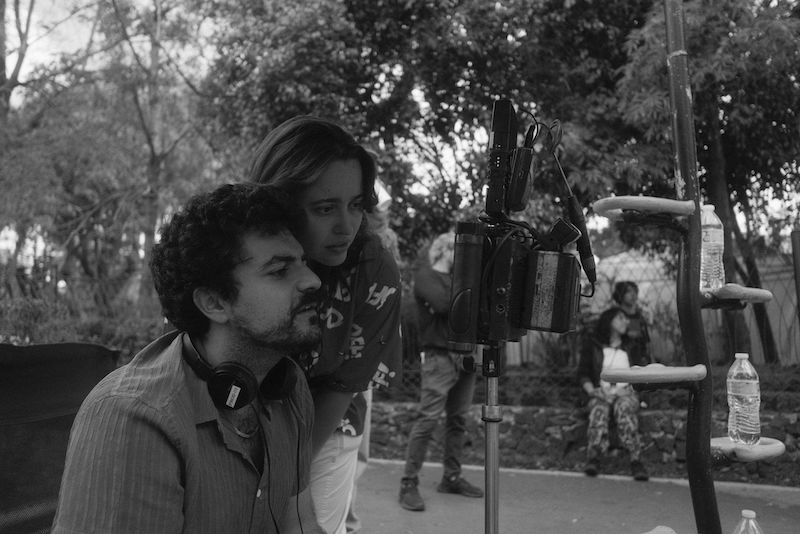
Writer-directors of Susana, Gerardo Coello Escalante and Amandine Thomas. Photo courtesy of Gerardo Coello Escalante.
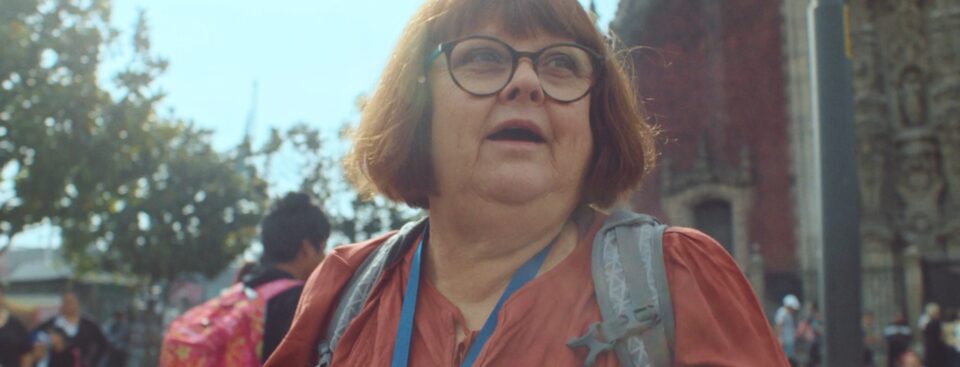
HOLLYWOOD, CA (LA ELEMENTS) 8/15/2025 –Susana, the second in a trilogy of short films by writer-directors Amandine Thomas and Gerardo Coello Escalante, opens with a vibrant kaleidoscope of images seen through the eyes of the titular character who is vacationing alone in Mexico. Bonnie Helman brings a poignant dimension to her portrayal of Susana, infusing the character with a captivating, child-like wonder. We see this immediately in Susana’s reactions to the sights of “Aztec warriors,” the sounds of the ritual drums and the evocative scents of sacred ceremonies in the public square.
Swept away by her surroundings, Susana moves as if in a dream. Her reverence for the people and the place that she is visiting is clearly heartfelt. However, Susana soon gets a rude awakening when she collides with Roxy (Christine Spang), spilling Roxy’s drink on her blouse. It speaks to Susana’s innate kindness that amidst Roxy’s rushed apologies, her response is to sincerely reassure Roxy that “everything’s OK.”
By chance, they cross paths again at a restaurant where Roxy introduces Susana to her close circle of friends, all vibrant and seemingly in their twenties like Roxy herself. Enchanted to be in their company, Susana is drawn into their world. It is here where directors Thomas and Escalante capture so well a subtle undercurrent of superficiality. Amid the group’s interactions with Susana-marked by excessive compliments and gushing enthusiasm-there is also the slightest veneer of artifice.
When Susana later joins them at a nightclub, the appearance of a child at their table trying to sell flowers illustrates a divide between Susana and her new companions. Like Susana, her new companions are American tourists. Unlike Susana, their sense of entitlement while vacationing in a third world country is simmering just underneath the surface. An entitlement not lost on the people for whom Mexico is actually home and who find themselves having to cater to tourists to make a living.
Despite her observations, Susana cares for her new friends and believes that they accept her as one of them.
This film builds up to a central question: When reality reveals itself, will it be a rude awakening or not for someone who sees the good in everything and everyone?
Whatever happens, Susana has embraced a country that will embrace her back. As all tourists who have a love and respect for the culture of the country they are visiting are embraced. And as all tourists who have the money to spend are embraced.
Susana screened at the 2025 HollyShorts Film Festival as part of the “Golden Age” program.
We reached out to directors Gerardo Coello Escalante and Amandine Thomas to learn more about the making of Susana. The following interview conducted by Editor-In-Chief Elva Zevallos, has been edited for length and clarity.
What was the inspiration for this film?
Gerardo Coello Escalante
Well Susana is inspired by our travels throughout Mexico and seeing the tourism culture and the different types of tourists that come to different places in Mexico. Particularly, we were in Oaxaca and we were seeing the contrast between very young American, European tourists, coming to party and the contrast with these two elderly British ladies that we saw traveling, all decked out with hiking sticks and their guides. It was a little bit the contrast between these two different types of tourism and the tourist depiction of the places that kind of inspired Susana for us.
Amandine Thomas
Just overall conversations that we had about gentrification in Mexico and what it can do to your soul to possess a currency that is of a higher value than the currency in the country that you’re visiting.
The film opens with such a dynamic image of the dance of the Aztec warrior.
Gerardo Coello Escalante
He’s a performer that performs an Aztec dance. They are very common in the main public square of downtown Mexico City where the center of Mexico Tenochtitlàn used to be and that’s where most of these groups of Aztec dancers perform. So we really wanted to open the film with this dance. It’s so striking but it’s also become such an image for tourism in Mexico City.
One thing that I thought was so striking in this film, and it’s really a credit to the directing, is when Susana is with Roxy’s friends. On the surface, they’re friendly and they’re very free with their compliments. At the same time, there is a level of falseness to it. It wasn’t so out in the open, but it was there. It kind of sets the stage for what ultimately happens to Susana.
Amandine Thomas
We’re really interested in characters that feel real which is kind of silly to say, I think a lot of times in looking to make archetypes, I think it can be easy to make clichéd characters or characters who don’t have really an inner life that is complicated and nuanced. And we are most interested in that kind of work and that kind of exploration. We tried to do that with all the characters, Susana included. The easier version of this would have been to make her into a villain or a horrible American, but that doesn’t feel real and that’s not effective. We really wanted to capture the feeling of being on vacation by yourself and being really incredibly alienated and lonely just by the nature of that you’re in this foreign place where you don’t know anyone. You’re just making vacation friends that you’re never going to see again and the vulnerability of that.
I actually think it’s less about necessarily individual behavior and it’s more about the overall corruption that we wanted to explore. Gentrification in this kind of Neo-colonialist tourism culture, it’s really something that’s bigger than us all. We really wanted in this film to tell a story that actually looked directly at the viewer, literally. That’s not something where you can walk away and say, “Oh that’s so horrible what those people do.” It’s more complicated than that and I feel that as an American living in Mexico.
What was the casting process like? How did you find Bonnie Helman?
Amandine Thomas
We found her on IMDB. We were looking to cast for another project, and we came across her. We already had the idea for Susana and then we really honed in on the script kind of with her in mind. We reached out to her, and she was down. Gerardo and I cast most of the film. We cast locally, as we scouted we spoke to people in the locations that we were scouting, and cast people who actually work in those locations. The Americans were a mix with the casting director that we worked with. They were a mix of some of my friends and then some actors in Mexico City.
In regards to the location shooting, some of it was shot here in LA. Is that correct?
Amandine Thomas
Well yes, we did one pick up scene in LA. That one scene in the hotel. Everything else was on location in Mexico City.
In terms of some of the non-creative aspects of making this film, obtaining permits for location shooting, things like that, how does that process compare in Mexico City and Los Angeles?
Amandine Thomas
We didn’t really get permits.
Oh. Good for you!
Gerardo Coello Escalante
We were also a very small crew. We were very nimble. The crew was way smaller than probably what you would imagine. It was basically a documentary-style approach to a narrative for all of our exterior locations to have the smallest footprint possible. In that regard we did not ask or need any sort of permit to shoot those scenes.
That’s good to hear. I know that in LA, there have been complaints about the bureaucracy involved in shooting a film. So much is about getting a permit, getting a waiver..
Gerardo Coello Escalante
One thing that was very great, that was very instrumental about this film is creating personal relations with the people at each location. And really getting to know them, talking to them about the film, what the film is about and what we want to say with it. They all wanted to be involved and that’s why they lent us the location most of the times for free and they helped facilitate a lot of things because they were part of the process in many ways.
What do you want people to take away from your film? In your film we do see how much better tourists are treated than the people who live there.
Gerardo Coello Escalante
We don’t really like being prescriptive of a message to take away from our films because we love these conversations. We love hearing what people thought and what came to their minds. What the film made them think about or question in their own selves or in people that they know. So we don’t really want to say, “It’s about this or that specifically.” Because it’s really about the entire conversation and we just love to hear what people have to say after they watch it.
Amandine Thomas
I think it’s also been interesting to find that different people find different things out of it. I feel that’s the most interesting kind of film.
Gerardo Coello Escalante
And it’s the most rewarding to us as filmmakers.
What is next for you? What’s your next project?
Amandine Thomas
We just made our third short in this trilogy that we’re so happy to have completed. The trilogy being, Viaje de Negocios, Susana and this new film called Albatross. So we’re in the edit for that and we’ll be finishing soon.
Susana screened at the 2025 HollyShorts Film Festival as part of the “Golden Age” slate of films.
On our cover: Bonnie Hellman as Susana. Photo courtesy of the HollyShorts Film Festival.
Susana
Directors Gerardo Coello Escalante
Amandine Thomas
Writers Gerardo Coello Escalante
Amandine Thomas
Executive Producers Ana Cardona
Nikola Duravcevic
Constanza Perez
Etienne Talbot
Cast
Bonnie Hellman Susana
Christine Spang Roxy
Parth Shah Kenny
Follow the HollyShorts Film Festival on Instagram and X

No Comments